




Category Archives: Gunnas-Masters

Bridging Common Ground – understanding ourselves so we can connect with others – Lara Stone

Another brilliant piece from a GUNNAS WRITING MASTERCLASS WRITER.

Deciding to design workshops about building positive relationships between Aboriginal and non-Aboriginal people was easy. A friend and I were always talking about our two cultures – hers Aboriginal and mine a mix of eastern and western – and people kept asking questions until we realised we need to share what we’ve learned together. We knew there were lots of other workshops out there but we also knew we wanted to take a different approach. We wanted to show people how we have built shared understanding.

But why would I have an interest in this when I’m not Aboriginal myself? Why would I even be involved? What would I have to contribute? Why does it matter to me? Why is it important enough to me to spend so much time on it?

Why am I trying to make a difference? Because I can’t not try to make a difference. Every part of my being knows that the experience of many Aboriginal people in Australia is not okay. Since I was nine years old I have had amazing Aboriginal friends who have enriched my life more than I can say, and over that time it has broken my heart to see how Aboriginal people experience casual racism and discrimination in their day to day lives from childhood onwards and that is not okay. When people spoke to my Iranian Dad as if he was stupid just because he had a foreign accent, it cut me deeply I was affected for life. When I have seen people, especially children, treated as “less than”, I have seen them become smaller and their world became smaller. I knew that something was deeply wrong. I cannot accept a world that makes children feel small.

I believe there is a better way forward. I believe taking a positive approach, starting with what we all have in common and how we see ourselves is a way to help us all to see the experience of others. I believe all people have the ability to celebrate others and bring out the best in everyone. I believe the greatest gift we can give a person is understanding, acceptance and respect. To say “I see you and I value you”.

I believe we get more from life when we connect with others and I believe this starts with understanding ourselves.  So we decided to create workshops that give people a look into the world that I’ve been lucky enough to experience a part of. To talk about the wonderful things that I have learnt through my friendships and the things that have enriched my life.

Will this change the world? Probably not. But if I can take one step each day to contribute even a little bit to building shared understanding between and respect for Aboriginal people, then by this time next year I’ll have taken 365 steps towards building common ground.
Go Back

A Beginning – Steven Walsh

Another brilliant piece from a GUNNAS WRITING MASTERCLASS WRITER.

Once upon a time there was a small village.  The inhabitants of this village were quiet, keeping mostly to themselves.  Visitors were always welcomed with open arms, and the villagers were happy and content, going about their daily lives with little concern for the outside world.

On a day much like any other, the sea breeze wafted in gently rocking the fishing boats in the port, raising small clouds as it passed up the dusty streets, and following the gentle incline up the valley.  Birds sang, dogs barked, and a small boy sat savouring the sun on his face, clutching his brand new shoes to his chest with unconcealed joy.

Towards midday a shape crested the horizon of the hills surrounding the village and began to make its way slowly down the road to the sea-side community.  As it came closer the shape resolved itself into a wagon.  The large wooden structure looked like it was originally designed to carry some form of cargo, but it had been converted into a make-shift mobile home.

Every day, the boy and his friends kept one eye on the road as they played, looking out for travellers or traders who might bring some news, trinkets or other excitement to add to their otherwise largely predictable days. Hence, as as the wagon continued down the hill, the children ran from their play in the streets up to inspect and greet this new arrival. Rushing and racing each other the boys were quite close before they took much notice of the solitary figure behind the reins of the large black stallion which pulled the wagon.

“One day”, boomed a deep voice startling the boys to a halt. “you will run into someone you will be less eager to greet”, and as the figure raised his head the boys recoiled at the dark angry face which now regarded them with its unwavering gaze.  Time seemed to halt, and the children momentarily failed to realise that the black beast was still moving ponderously towards them. It took one of the younger children deciding the turn and take flight to startle the others into a similar course of action.

It was this headlong, panting rush of children tearing back through the village which caused Dom to stop his work and step from the smithy to glance up the hill and regard the stranger, and because of that to also take in the distinctive markings on the flag fluttering above the wagon. This was a day Dom had known would come. The Founders had arrived.

Astride the wagon, Founder M met the eyes of the figure who emerged from one the buildings, and returned his gaze until finally the figure moved from the doorway towards the middle of the street to await him.  “Good” thought M, this was a man who could potentially save him from much heart-ache.  It was always a sensitive thing, entering a new village, the Founders reputation proceeded them, but many listened to the stories and heard only things to fear.  Few, like this man, seemed to grasp the greater purpose and truly understand that this was not an occasion for running or alarms or pitchforks.

M directed his horse toward the man and proceeded down to initiate the meeting which would truly decide not just the direction of the day, but the future of a nation.

Go Back

Middle aged manifesto – Zita Pal

Another brilliant piece from a GUNNAS WRITING MASTERCLASS WRITER.

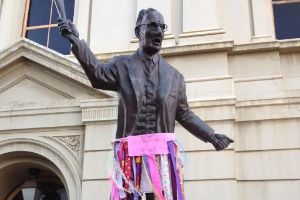
At 5.30 in the morning on International women’s day, 8 of my women friends and I  dressed in high viz gear adorned the statues around Fremantle with skirts and ribbons. We did so because we wanted to put into action our frustration at the lack of public art representing women.

In Fremantle  we have statues of a Prime Minister, a pop star, fisherman, an immigrant a sculptor, footballers, an engineer even an abstract human. All men.

It was fun, and for some a little daring but by 8.00am evidence of our work was all but gone. In a city that prides itself on its history of creativity and as a home to the arts, this small act of  public disobedience  was as if it didn’t happen.

The theme of International Women’s Day 2016 was a Pledge for Parity. On the agenda were big picture  issues, like job opportunities, work place discrimination and closing the wage gap. For us , a group of women whose youngest member is 51, our aspirations were more modest. It was opportunity to raise public awareness about the absence of female representation in the cultural narrative of our city.

We sent out photos and press releases but got very little traction. IWD breakfasts, speeches and political announcements dominated the news cycle. But like our bronze counterparts, we were all but invisible.

As middle aged women we are no strangers to invisibility. Next time we will use it as a weapon.

Zita Pal owns South of the Border

Go Back

What I think I mean when I talk about running – Amanda Gower 

Another brilliant piece from a GUNNAS WRITING MASTERCLASS WRITER.

There’s a book called “What I talk about when I talk about running”. I think it’s by a Japanese author; I could be wrong. I tried reading it several times, mostly because I should. I love running and I love others who love running, and the author was Japanese. Very high brow. I just couldn’t quite turn my attention to someone else’s story of the long miles – it just wasn’t interesting. But I have often wondered what my own running story was.
As I sit here nursing a very painful shoulder (which has a date with a heat pack very shortly), as I as I try to ignore the guilt I am, again, lugging about from missing all but one training session this week (said guilt is probably sitting on said shoulder), and as I flex my right toes in and out in a vain attempt to loosen my plantar for tomorrow’s race, I wonder why I love running so much. Because, like writing, it sucks. It hurts. I’m either waiting for the pain to start, or waiting for it to stop. I fail more often than I pass. I can’t remember the last time I exceeded expectations since the glory days of 2007 when we used to go for a quick 15(km) run before coffee, when I was first to arrive at the 5am run meets, and I effortlessly inched my way towards my first marathon. Nowadays, bits chafe. Toe nails bruise and then fall off. Other bits cramp, strain, blister, fail. I’ve never been Good again.
Running sucks.
And I’m an addict.
Aren’t I?
I read once that users of crystal meth only have one amazing high, and that’s the very first time they take it it’s like a sexualised, slash euphoric, pleasure; so glorious and fulfilling that they create a self-harming career trying to recreate that first time.
Except here’s the catch. You get one, and only one, first time. That’s it. Game over. It will never ever be the same again. Even if you double the dose every week until it kills you.
Now I’ve never been a user of meth (red wine is my drug/carb of choice) but that sounds VERY MUCH LIKE my running.
Why am I still running? Am I really in a committed relationship with the love of my life? Or am I a meth user trying to recreate that first time when the pleasure was so great that I can still feel it almost 10 years later? Am I addicted to the idea of what running was, or could be? Am I just chasing the high (while nursing another twinge of ITBS)?
Because when I talk about running, that’s what I’m talking about.

Go Back

This Boy – Bianca Hewett

Another brilliant piece from a GUNNAS WRITING MASTERCLASS WRITER.

Once upon a time there was the greatest band in the world. Do I even need to say their name? You should know, right? Okay, okay – I assume too much about my taste and your opinion. So I will just tell you, and you can humour me.

The Beatles.

Come on, you know it. Even if they’re not your number one, they’d have to be in the Top 10-20. Unless you’re some sorta indie douche. Although – maybe they are old enough to be hipster cool? I have no idea.

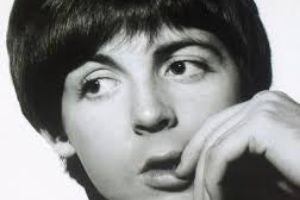
Anyway. My point is, I am trying to recreate this cool photo of Paul McCartney for my Insta. (Poptart1999 btw, I follow back) I have got the outfit. Black trousers, jumper – beige, although I am guessing here, the photo is black and white – white collared shirt and black tie, tucked neatly into the pullover, as my pom dad would call the jumper. Also the chunky gold watch, juuuust hidden under the cuff. My brows are totally on point and while I don’t have the camera he is using to take his selfie (totally meta, no?) I have printed out a pic of it and put it on cardboard and cut a hole so I can hide my phone behind it and take the pic. The logistics of how I will hold the pose and take the photo currently baffle me. Either way, the whole idea is kinda genius.

Every day leading up to this epic selfie of a selfie I have been wondering if I should go for the hair, too. Artistic integrity/sacrifice and all that. Little bit Ruby Rose in execution, Lady Gaga in showmanship. Not quite sure how I’d go pulling the lads with that do, but meh. Least of my worries, really. Contouring is where those lie. I have to nail the deep-set eyelids, the light stubble above the bow lips, and the dimpled chin.

One day I will master this stuff. Stuff being contouring plus life. Shit. What must you think of me already? Self-obsessed, social media whore teen. Perhaps you wouldn’t be wrong. But it ain’t as if I am chucking a duckface in my parents bathroom, toothpaste spattered mirror in the background and crumpled towels on the floor, in my undies. I am trying to give my minion followers some history and culture, yo.

Because of that, that leads my to the conundrum of the ‘do. Yeah, I know I am not Sigourney in Aliens or the American Psycho Batman dude who lost all that weight. It is one photo. But maybe it is just that one photo that makes you. Invents, or reinvents, as the case may be. Not just like everyone else, but a risk-taker or an artiste. A unique snowflake. Anyway – my sis is keen to have at me with the scissors…

And because of that, I have become some sort of half legend/half weirdo. My Insta peeps ate that shit up. With lots of vacuous Yasssss! You go! and #shelovesyou comments. Course there was the homophobic shit but I feel like if I am confusing and confronting people? Good! At school my friends were all, ‘It’ll grow back!’ Whatevs. Once I would have been, well. Once I wouldn’t have done any of it.

Until finally, I decided to stop waging self wars. I decided that no fucks would be given. I’d think of what society wanted me to do and do the exact damn opposite. I mean, not like breaking the law, but like, having Paul McCartney hair and not shaving my bits every second day, and running cos I love it and eating a double whopper cos I crave it.

My dear ol’ mum calls me precocious and I don’t deny it. She tells me self-awareness is a scary and beautiful gift. She says I am awesome and quirky (mum code for lovably strange) and the best thing she has created. Naw, shucks.

However, I digress. I was actually wondering if you’d like to come on an adventure with me? There’ll be kissing stories, descriptions of meals, betrayal and youtube cat videos. I might even show you that photo, if you’re good. <insert winky emoji>

Bianca Hewett

http://diaryofanasskicker.com/

https://www.facebook.com/tmibee/

Go Back

Mercedes vs Shit Box – Michelle Thomas

Another brilliant piece from a GUNNAS WRITING MASTERCLASS WRITER.

Once upon a time there was a black Mercedes, a zipped-up, low-to-the-ground number that oozed status and symbolism from every curve.  The brand-spanking new car was owned by the father of my son’s new friend; a nice enough fellow who was clearly proud of his kids, but was probably more proud of his wheels.  Who could blame him for that?  Even I, a luxury car ignoramus, could tell that this one was something special.

His son had come to play at our place with my seven-year old after cricket on one of those blistering Perth summer mornings.  It was stinking hot.  The kids were ratty, and the parents even more so – two hours in the sun was affecting everyone.  We were milling around at the end of the cricket session – James my son was scouting for potential playmates.  He eyed a new friend of his, George.

“Does James want to come to our place?” the father (let’s call him Mr Mercedes) had asked.  No, I said, it’s fine, we live just up the road from the oval so how about George just comes home with us.  

I asked him to swing by to pick George up from our place at around eleven.

Which he did.

In the Merc.

I watched him park in our driveway and saw a flash of recognition in his face as he smiled towards our neighbour and trotted towards him, hand outstretched.  The two were old Uni friends, apparently, so Mr Mercedes wandered over to catch up with his old mate.   I stood and watched watched from the window for a minute, not wanting to be too quick to open the front door and head out to greet him.  (I wouldn’t want him to think I had nothing to do but watch and wait for him to arrive, was my logic).

So I was in the prime position to watch the unfolding meeting of the vehicles.

My car is everything that the Mercedes is not.  An ageing Australian classic might be a polite way to put it, but “classic” is far too generous a term.  Really, it’s nothing more than an old shit box.  It grinds and groans whenever I turn too sharply to the left.  Or to the right, for that matter.  Sometimes I try to catch the eye of other drivers to see if they can hear the groaning noises as clearly as I can.  (No one has let on that they can, but I’m sure they’re just being polite).  It’s never clean, and that’s because I don’t really see the point.  I have no attachment to my car.  I laugh about it to my friends, and I pretend that I don’t care, but I actually do.   I wish it was something else.  And every time I turn the wheel and the shit box emits its groan, something inside me twinges with shame.  One day, I’d tell myself, I’ll get a new car.  Nothing flash, but hopefully quiet.

On this particular day Gary my husband needed to use the shit box.  He never drives it, but it has one advantage – it’s big.  It’s just the thing you need to get your stuff home from a trip to Bunnings.  The timber planks could stretch comfortably from the back bumper bar through to the front window.  The shit box was in demand, and Gary was, as usual, in a hurry.

He’d told me that morning he’d be leaving around eleven.

Apparently it’s almost impossible to use a rear view mirror as intended (that is, to see what you might be backing into) if you are reversing up a hill.  And our garage just happens to be at the bottom of a hill.  The Mercedes was parked at the top.

The noise from the Australian classic wasn’t so much of a groan this time as a sickening crunch.  Metal struck metal.  Shit box struck Merc.   Merc came off second best.   The sleek panel over the rim of its front right tyre had been reduced to a crinkled mess, and it took the efforts of three men – husband, neighbour, and Mr Merc himself – to pull the rim away from the tyre so that the wheels could turn and car could be driven away.

“Totally awks, Mum”, said James, as the car finally backed out and gingerly crept away.

“You can go to his place next time.  I’ll walk over to pick you up.”
Go Back

MY LIFE AS A COW-Beverly Barry

Another brilliant piece from a GUNNAS WRITING MASTERCLASS WRITER.

Years ago, a very good friend of mine confided to me that for span of several years, while her children were very young, she was a cow. Not a female person unfortunately inclined to behave badly to others, but an actual cow.

I was in my early twenties at the time and generally clueless when it came to relationships between mothers and their very young children. My relationship with my own mother was strained, at best, and I didn’t yet have children of my own. So, while this revelation of my friend’s was remarkable enough to be remembered when so very many others were lost, at the time that she said it, I didn’t know what she meant. At least, I was aware that it didn’t really have to do with breastfeeding (maybe a little bit, at one time?) but it’s less obvious implications were beyond the reach of my capacity to understand – shadowy things, less substantial than smoke and just as difficult to grasp.

I do get it now. I have had very young children and there were days when I, too, was a cow. Probably both sorts at once. I was a source of food, a propagator of another generation of my kind, a creature enslaved to a mundane daily ritual involving milk, nurturing and lots of walking; and when prevailing conditions were stormy, I turned my arse to the wind and rain and tried to keep the worst of the weather out of my face.

My children represent the best of my life. I love them dearly and nurturing them is my privilege. But at that time, I lost my higher functioning self, my last best version of myself, and became a cow for a while. As far as cows go, I think I did alright. I quite like cows actually. But I am forever grateful to those other mothers in my life whose care and conversation – whose presence in my kitchen on windy, rainy days – helped me to re-integrate my soft-eyed cow with a newer alternative version of thinking, mostly-human woman.

Go Back

The beaching – Pia Smith

Another brilliant piece from a GUNNAS WRITING MASTERCLASS WRITER.

Describe the beach. I left my shoes under that tree that is no longer there. I left that tree behind a long time ago and walked off barefoot, never looked back and now, looking out this window, looking back, the shore is so far away. The window is round and a gull soars past and I can’t see which way is back because all around me is sea, sea, sea. So tranquil.

Describe the beach, describe the beach.

I waited.

The sun slanted into the kitchen, it was late afternoon and that old radio was on, before you swiped it off the shelf just like that, you said ‘Enough of those voices, that infernal music, why can’t we all just be QUIET?’

Describe the beach describe the beach describe the beach.

By the time we got there our footprints were long gone and the sand was strewn with starfish. There must have been hundreds of them, all beached, all grey. Perhaps in the water, before, they were luminous, but now they were such a dull grey, like the sand, the sky, all such a dull grey, the only light emanating from behind the waves, the Indian ocean glowing jade green under winter’s white foam. Occasionally one of their legs moved, twitched a last flick of life before stillness, the absenting of life, the last star going out before everything turns to dust.

Describe the beach. Long, quiet, ten minutes end to end. One step before the next, on the liminal shore.

Go Back

Sea Shells – Essjay Tee

Another brilliant piece from a GUNNAS WRITING MASTERCLASS WRITER.

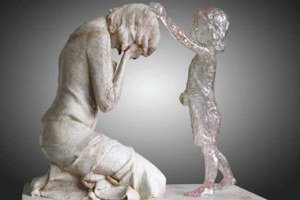
She looked at me like she knew me already. She didn’t ask questions but she told me her stories openly and freely.  We sat in her clean, sparsely-decorated, empty home. On the mantelpiece sat five shells.  One shell for each of her miscarriages.  Each was vastly different, as each loss had been.  There was a jagged white one – the first, she told me – a small blue one, another white shell, a red-tinged one and a purple one.  I imagined her walking along the beach, tears in her eyes, and a hole deep inside as she collected rocks and shells, feeling them between her fingers over and over before pocketing the right one.  Five sad trophies side by side in a lonely house. “I couldn’t do it to him anymore,” she said of her absent husband “I couldn’t do it to myself anymore.”

I sat in silence on the other side of the room. My story was different to hers, and one I could not tell her; one she could not hear.  I did not pick out a shell, or any other rare treasure from the sea after my abortion. I didn’t see the foetus as a baby, as a life. Pregnancy was a condition I was desperate to be cured of. I needed distance between me and him and I aborted the thing we made that would have glued us together for the rest of our lives. It was not sad, and there was no remorse. It was clean. It was clinical. I signed some paperwork and changed into a paper gown and put my legs in stirrups. And when I woke up they fed me miniature sandwiches and apple juice.  A friend drove me home where I slept some more and in the morning I packed one suitcase and took the train to the airport. I couldn’t handle looking into his eyes one final time, nor being held hostage by his mood swings and inexplicable rage. On the bench at home, if he looked, he would find my note: “You already know why.” If he didn’t see it coming then he’d never understand the leaving; he didn’t deserve the explanation he couldn’t understand.

“Do you think you’ll have children one day?” She asked me hopefully, a sad smile on her face. I looked at her collection of shells before I met her eyes “I’m not sure.” I shrugged gently.

Go Back

It Didn’t Happen Overnight – Gem Adamson

Another brilliant piece from a GUNNAS WRITING MASTERCLASS WRITER.

Once upon a time there was a woman who became a mother. It didn’t happen overnight. Obviously. It started over night but then took 9 months to come to fruition. After nine months she had a round wrinkly little thing that could do nothing but required everything. And the mother wrung the best bits out of the grey world that surrounded her to try and grow and stretch and toughen up this little beast. The sky where they lived was never visible. It was always cloaked in a dirty grimy blanket of grey, but she would leave the kid to roll around in the tiny outdoor space they had, to soak up whatever withered traces of sunshine it could.

Every day, she would strap the child to her front and hug it to her chest like a hot water bottle. They would walk through narrow industrial streets, with gritty gutters and wrappers collecting in the corners and alleys. They would walk to the baby girl’s childcare centre, which was full of bright light and primary colours. Then the mother would go and spend hours cutting carrots into items of intricate garnish for high end catering events.

One day, stepping across the threshold from the coarse and grinding city, into the smooth and shiny reflections and colour of the child care centre, the mother was hit by the contrast in a way she had never experienced before. She couldn’t leave the girl there, where there was no chance of skinned knees from angry gravel or scratches from misjudging a rough corner.

Because of that, she decided to take her child with her, back out into the grey, and try to find the real colour and softness and grit and texture that she knew was out there somewhere in the world. They started small. One bean, sitting in some rubbishy dirt in a mug on their kitchen counter, sent up two small leaves at the top of a tender stalk.

And, because of that, a little colour started to leach into their life. And the child soaked it up. They collected snippets of coloured wool and painted patches of garish wall. They grew tall sunflowers with awkwardly heavy heads and mixed colours that were against the rules. The child began to speak, and began to point out the snatches of colour that might otherwise have disappeared into the overwhelming grey of the sky and heavy cogs of the growling industrial city where they lived.

Until finally, the child had absorbed all that there was to provide light and life in that city. She had grown from a round, wobbly small thing, into an almost adult. What colour they could collect from they streets around their little flat, she had harvested, accumulated, carried in and arranged on the shelves and on the walls. And it was time for her to go. There was nothing left for her to feed and grow from. When she left her mother, and left the city, the colour and the variety and the possibilities of the rest of the world swallowed her up. Occasionally notes and pictures find their way back to her mother, little snippets of the countries she had worked her way through or the people she had met. Biology students in Guatemala, theatre directors in New York, orangutan rehabilitators in Borneo.

Her mother tried to be glad for the colour and life her daughter was moving through, but all she thought was “Oh my god I miss you”.

Go Back