





Category Archives: Gunnas-Masters

Question 100 – Anni Moss

This piece was sent to me anonymously by a person with legal training who works within the asylum seeker  processessing chain.

This is question 100 of the 102 questions on the 866 protection visa form that all asylum seekers applying for refugee status must complete. I can fill these forms out in my sleep, but I can’t read this question and ask people to sign without wanting to vomit and feeling a bit of my soul shrivel up and die.

  1. AUSTRALIAN VALUES STATEMENT

You must sign this statement if you are aged 18 years or over.

I confirm that I have read, or had explained to me, information provided by the Australian Government on Australian society and values.

I understand:

  • Australian society values respect for the freedom and dignity of the individual, freedom of religion, commitment to the rule of law, Parliamentary democracy, equality of men and women and a spirit of egalitarianism that embraces mutual respect, tolerance, fair play and compassion for those in need and pursuit of the public good;
  • Australian society values equality of opportunity for individuals, regardless of their race, religion or ethnic background;
  • the English language, as the national language, is an important unifying element of Australian society.

I undertake to respect these values of Australian society during my stay in Australia and to obey the laws of Australia.

I understand that, if I should seek to become an Australian citizen:

  • Australian citizenship is a shared identity, a common bond which unites all Australians while respecting their diversity;
  • Australian citizenship involves reciprocal rights and responsibilities.

The responsibilities of Australian citizenship include obeying Australian laws, including those relating to voting at elections and serving on a jury.

If I meet the legal qualifications for becoming an Australian citizen and my application is approved I understand that I would have to pledge my loyalty to Australia and its people.

Signature of applicant –

Date


Every day I meet incredible resourceful people who have sought asylum in Australia because they thought it was a good country where people were fair and welcoming – a place that “values respect for the freedom and dignity of the individual.” A free country that “embraces mutual respect, tolerance, fair play and compassion for those in need and pursuit of the public good.” People have lived through incredible hardship and risked their lives, and sometimes the lives of their families, to come here. They have not come for Centrelink or Medicare or to take Australian jobs. They have come for a better life, for what they thought would be freedom.

It is time to stop deluding ourselves. If we really believed in the “Australian values” that we made people seeking asylum swear to, we would stop torturing children by putting them in detention. And adult men, too. Women and children always gain sympathy, but let us not pretend that we are not traumatising nearly everyone we detain: people in need who have come to us for compassion. In the 2014 Lowy Institute poll, 59% of Australians said they wanted asylum seekers processed offshore. Trauma, sexual abuse, death – not happening in Australia, not our problem. We spend billions outsourcing the misery to contractors who profit by exploiting our indifference and complacency. We say we care about people drowning at sea, and don’t give a rat’s ass about people dying anywhere else.

Australia does not value “equality of opportunity for individuals regardless of their race, religion or ethnic background.” We all know some races and religions are more equal than others in Australia. For decades, the Catholic Church played a game of pass-the-paedophile while authorities looked away, and even assisted in covering it up. Why would we treat foreign children any better than our own?

I cannot even begin to imagine what “commitment to the rule of law” might mean to the current Government or Opposition. Fucked if I know. They make the laws, they make the rule.

I am trying to take the long view, as Malcolm Fraser recommended in matters of social policy, but it is getting more difficult by the day. We are doing too much damage in the short-term, damage we may never be able to undo. People talk of the ineptness of this government, but after a while, it begins to look like cruelty by design. The consequences are the same, whether we intended them or not.

Pledge my loyalty to Australia? Tell him he’s dreaming.
Go Back

The Kitchen Table – Judith Davies

Another brilliant piece from a GUNNAS WRITING MASTERCLASS writer.

The table is honey coloured kauri, with turned wooden legs and tiny pinholes on its surface from when it was once used as an architect’s workbench. At one end there is a square bolt. A crank handle attaches onto it, and turns to lengthen or shorten the table, allowing panels to be inserted or removed. It has never been shortened. Even now, with just the two of them in the house, it stands, ready to seat ten people.

The table is at the centre of the house, literally and figuratively. It sits in the middle of the large kitchen, with The Crucifix, Mary, and the Saints on the Columban Calendar watching over it from the walls. It was present for the ordinary, the important, the mundane and the life changing. Secrets were kept or told at it, there were fights and reconciliations, truths and lies, tears, laughter, love and hate. Babies were bathed, changed, and fed on it: eight babies in all, in 1950s and 1960s Christchurch.

At dinnertime, Grace was said at ever increasing speeds by the father, Dan, until he finally swallowed the entire prayer in one mouthful that took him less than 3 seconds to say: “BlessusOhLordandthesethygiftswhichofthybountyweareabouttoreceivethroughchristourlordamen”. Grace was the calm before the storm and the signal for the feeding frenzy to begin. Food that was liked was inhaled and unwanted food was passed covertly between siblings: Brussels sprouts in exchange for carrots, peas for corn, corned beef for cabbage. They guarded their flanks – there was always a danger of some bugger stealing your last roast potato (and once, an oyster) off your plate. That particular incident achieved legendary status in family lore. Even those who had not been born or were not old enough to remember, know every detail; of the overwhelming temptation of that oyster (an unheard of luxury) and the uproar its theft unleashed. In the 1970s a dog circled the table at mealtimes. His paws clicked against the linoleum like a metronome, waiting for any morsel to accidentally, or purposefully, drop.

Mountains of food were prepared and served on the table. Baking was cooled on it, meat was minced or breadcrumbs made with the hand mincer, which would be screwed onto one end. Every summer there was a production line of food preservation. They came home from school to the smell of tomatoes being made into sauce or relish, raspberry jam simmering or peaches and apricots being bottled. They were well acquainted with the paraphernalia and process of the production line, and they knew not to touch the pristine bottling jars or the lid seals sterilised with boiling water. Filled jars of jams and preserves were lined up on the table like soldiers on parade. Food was bought, grown, sorted, prepared and made in bulk. Trays holding three dozen eggs each were stacked into towers. Twelve pints of milk were left each morning by the milkman, and a side of hogget was devoured each week. Bread for the morning school lunch preparation covered every flat surface in the kitchen. Endless pots of tea were made: oceans of tea.

Margaret was a dressmaker who made clothes for herself and the eight children. It was out of pure financial necessity in the early days. Having grown up during the depression and war, Margaret was a product of the school of hard work and no nonsense practicality, enforced by a particularly unpleasant step-mother. She felt the loss of her mother, who had died when Margaret was nine months old, profoundly her whole life. She was a devout Catholic and Dan had become a Catholic in order to marry her. Some in his dry, Methodist family were less than impressed when he married an Irish Catholic publican’s daughter in 1953.

The sewing machine would be set up at one end of the table and Margaret would sew late into the night. Mary couldn’t get to sleep without the familiar low hum of the sewing machine. Later on, when there was a little more money, Margaret still sewed but more out of being practical and even out of a little pride. Patterns were trimmed on the table then arranged on fabric to be cut out. They stood on the table while hems were pinned and trousers were taken up.

Never ending laundry was sorted on the table, into piles like a city skyline. The skyline would be dismantled and put away only to return the following day. It expanded over the years into an urban sprawl of singlets, socks, shirts and undies. Once a week nine pairs of sheets would billow on the washing lines like an armada of ships under full sail.

They grew up around the table, reading stories, drawing pictures, playing games and learning spelling and long division then graduating on to algebra, essays, and verb conjugations. Checkers and Monopoly became Chess and Five Hundred. Friends, boyfriends and girlfriends arrived on motorbikes and in cars with beer and cigarettes for parties, or more often, to take the teenagers out of the house away from the watchful eye of the parents –and of Mary and all the saints.

As the production line of food and laundry slowed down it gave way to more time for Margaret. She had time to sit at the table and actually read the newspaper and solve the crossword or read a book; luxuries she had given up for years in order to do everything else. Dan retired and found himself at the table too. It took a while for them to realise there was room enough for both of them.

Margaret sat down on Sunday nights to write letters, a boarding school habit, to her children as they left home and moved further away. Most of them didn’t have the letter-writing discipline she did and many of her letters started with “Dear Paul/Jane/Frances/Mary/Patrick/Neil/Gerard/Kathleen, “It’s been such a long time since we have heard from you….” Cue guilt. Her letters were full of details of the house, the baking, who was doing what, whether Daphne or Freesias from the garden were in the vase on the table, who she had seen at Mass. The recipients had mixed feelings on receiving these letters at different times in their lives: the angry 20 year old who couldn’t get far enough away, the homesick 30 year old half way across the world, the new parent desperately trying to remember “what did mum do?” for a baby with colic. As time went on the words, “Do you remember ‘such and such’? Well, they died last week”, became more common. News of weddings and baptisms were replaced with details of wakes and funerals.

The four of them sitting at the table that Tuesday lunchtime as the earthquake struck, thought they were going to die, as they clung on to it like a lifeboat and the earth heaved up and flung them around like rag dolls. But they, and it, survived. Family and friends, girlfriends and boyfriends, husbands and wives have come and gone. A young couple became an old couple and eight babies became eight adults. The table sits, constant in the kitchen.

Go Back

The Pitch – Jane Kiddell

Another brilliant piece from a GUNNAS WRITING MASTERCLASS writer.

“I can’t believe how stupid some people can be and that I let them make me lose confidence in myself – pass the M&Ms.”  – Noelle

“He just presented my training plan to the committee as his own work, but he stuffed up the theory and called it the 70:30:10 model – he wrote it on the slide and everything – AND NO ONE NOTICED…”  – Eliza

“We’ve just sat in a strategy meeting with five IT professionals for over an hour.  No agenda, no actions, just an ego-fest of technical jargon one-upmanship.  One of them actually said to solve the problem we’d have to “eat the elephant, one bite at a time.”  Every time we tried to ask a question or get back on track we were talked down.” – Noelle

 “At the end of the hour the blokes had “squeezed the lemon dry” and were high-fiving themselves over how well they were taking carriage of the situation on the way to the coffee shop.  Everything relevant to the purpose of the meeting had been taken off-line and parked in the car park before needing to be added to the swim lane on the PMO wall by the overworked project co-ordinator.” Eliza

This has been a standard day for Noelle and Eliza – EVERY DAY FOR THE LAST 5 YEARS.   Their collegial friendship is made invincible by daily venting and the number of  “Oh Fuck Off’s” they have incredulously shared.

Together their work is spectacular.  Creative, detailed, and awesome. But has anyone actually noticed? Can they survive another restructure and a manager who bans talking in the workplace?  Why can’t they leave?

Solutioning.  A TV comedy. Such diabolical bad behaviour in the workplace, it’s laughable.


Go Back

Using my own ideas – Rachel Stewart

Another brilliant piece from a GUNNAS WRITING MASTERCLASS writer.

I don’t write because I want to write. I write because I need to write. Writing is how I collect my own thoughts, how I frame my own ideas, how I work through my own shit. If I stop writing then I don’t know how else to process my own thoughts. Whether it’s writing a diary, or blog post, or even just lengthy Facebook status. It helps me think, focus, and make some sense of the mess and noise that goes on inside my head most of the time.

But writing it purely for myself – for no one else to ever read – isn’t enough, because tossing my own ideas back and forth between myself feels a little bit pointless.

Sometimes after I’ve written something and I read it back to myself I wish I’d written it sooner – so I could have read it sooner. And I think my own ideas could be helpful to someone else, or more importantly be something that someone else can relate with or connect to.

Because if I can achieve absolutely nothing else with my writing all I would want is to connect with people and have someone read something I’ve written and say “Me too”.

Check out Rachel’s fabulous blog Parenting Central here.


Go Back

Holistic Hagrid – Elizabeth Lucy

Another brilliant piece from a GUNNAS WRITING MASTERCLASS writer.

Hagrid danced as best he could – he would live to throb another day.

I had never been to a holistic doctor before. Maybe that should be Holistic Doctor. I paid through the nose – and what did it buy me? It bought me a personable woman, younger than me, who said things like ‘bone broth’ ‘adrenal fatigue’ and directed me to a favourite website where I could order the supplements she recommended. I paid a lot, so I had her to myself for an hour. The medical history she took was exhaustive. Right at the top she asked whether there was anything particular I wanted looked at, other than the normal blood tests.
“There’s a spot under my eye that keeps flaking and is sometimes itchy…”
“OK, I’ll have a look at that.”
“…and I have an enormous haemorrhoid. I’m scared my bum is broken.”
“We’ll have a look at that too.”
She continued taking her very in-depth history and we eventually almost reached the end of the one hour consultation time. I had to haltingly prompt her to to assess Hagrid the Haemorrhoid; she appeared to have forgotten.
“Lie over on your left side… OH! Oh. Yes. OK. What are you putting on it?”
I resisted the urge to say ‘human growth hormones’ and told her the name of the ointment.
“OK, I’ll have a look at what’s in it.” She scrolled through the ingredients of the medication, and then compared it to another that she had listed. “Try this one – it might be a little more effective, but it’s possible you might have to have it injected…in order to shrink it.”
“INJECT it? Is that a thing?”
She nodded, and printed me out a prescription for what I hope was ‘The Incredible Shrinking Haemorrhoid Ointment’.
She was so struck by the enormity of Hagrid that she never looked at the spot under my eye.
After I paid, through the nose, and had my blood drained by a pathology nurse who I felt could have chatted less and concentrated more, I sat in my car and looked at the prescription. It had something on it I had not seen before (as a longtime holder of a Health Care Card). It said ‘Not Available Under PBS’. I decided to ignore that, but I had my suspicions.
The pharmacist confirmed them. “Are you aware that this isn’t available under the pharmaceutical benefits scheme?”
“Oh. I went and saw an expensive Holistic Doctor. How much is it?”
“An expensive Holistic price. Forty-five dollars a tube.”
Hagrid pulsed with hope. Holistic hope.
“Forget it. I’ll keep using the stuff I’ve already got.”
“And what’s that?”
She looked it up and rolled her eyes, just a little bit. “Use that, but use it a bit more often.”
Go Back

Bite the Bullet – Christine Hayley

Another brilliant piece from a GUNNAS WRITING MASTERCLASS writer.

not a slap in the face
more like a brick to the head
put you back in place
no words left unsaid
Viv understood why she got into trouble. They made sure they spelled it out. They had also made sure that she would never forget. She had run back to her room and crawled under the covers. There she silently howled. It wasn’t long before she returned to the kitchen. She swiped some stale biscuits, stuffed them into her rucksack, and then headed outside. It always helped her feel better being out in the open and away from the house where the walls squeezed her in so hard she felt her chest compress into stone, making her insides heavy and black. Outside was the remedy, even though lately events out here were starting to worry her as much as the stuff going on inside the house.
Stomping to the rhythm of her pounding heart, she crossed the park down the street. She didn’t expect to see him there.
“Why didn’t you come to see me?” he asked.
“I was held up. They found out.”
“Come on, let’s get out of here.”
Down the track they came across the sign they had been looking for. The animal had been dead a short while. Picked apart by something and now all manner of insects had started to swarm. The sight made Viv want to vomit.
“Don’t touch it, Ben. That’s foul.” But Ben already had a stick and was poking it in its guts.
                         “I just want to make sure,” he whispered. Looking up sharply he pointed to something in the distance. “I think we should head there.” Following his lead, Viv stayed close to Ben’s heels as they cut across into the wooded section of park. It was late afternoon and the light here dissipated into bottomless shadows. Viv couldn’t deny that this place creeped her out. She would never have come here alone. Ben pretended to be the brave one, but a look of worry darkened his eyes. Now that the others knew, their time was up. No more guesses, no more theories. They just had to bite the bullet and chase. That was the only way to find out the truth.
When faced with the choice of do or die
you can’t truly know if you’ll make it out alive
The deeper in they went the more curious Viv felt. It was like now that she was in the thick of it, a different person was appearing. As Ben began to fade into a hapless ghost, Viv stepped forward to lead the charge. There was no turning back now. Back at the house she would lose everything, all privileges gone. This will be her last chance and she wasn’t going to back down no matter how terrifying the prospect of facing this creature was. It was time to get to the bottom of this thing and find out what exactly was doing the killing. Squinting her eyes she paused and held her breath.
Viv sensed the movement first and ducked to the right. It whooshed past her left ear and hit Ben’s shoulder full force and threw him to the ground. There was no way he could see it coming as he hid behind his friend. Viv lost her footing and precious seconds as she stumbled to catch herself. By this time Ben was up and they both set for the chase. As it weaved through the tall trees the creature seemed like a shadow in the fading light. It was fast, too. And soon enough it was out of sight. It all happened so fast, neither had the chance to fully grasp what they had seen. They both knew, however, that it was not something that they had ever seen before. Not in real life.
“Was that for real?” wheezed Ben. His breathing started to shut down in the cold air and after all that running.
“I have no idea, ” said Viv. Her breath condensed in front of her as she spoke. “No matter what they say back at the house, we have got to work this out.”


Go Back

My Nonno loved Mussolini – Elise Pulbrook

Another brilliant piece from a GUNNAS WRITING MASTERCLASS writer.

I don’t remember Nonno singing to me as a child, but he sang to me as an adult. He sang about Mussolini. He sang from his kitchen chair with his oxygen mask at the side of his face, tubes from his nose, wearing his navy dressing gown, sunglasses and Nonno hat. It was an anthem he’d learnt as an adolescent, living in Soveria Manelli, a small farming village in Calabria, at Italy’s toe.
The song was rich and powerful. He became full of life and inspiration when he sang the Mussolini anthem. He told me it was sung by the masses when Mussolini came to visit their village. The people wore red, wore flags and cheered for their icon. My Nonno sang loudly. He had a wonderful, deep singing voice. He would bellow this song, of which I can only remember the tune and the way “Mussolini” was expressed with clarity and pride. Nonno would explode into life, this song being the climax of this boyhood story, and then he would retreat. He would fall back into his chair and back into the world of his kitchen table in Thornbury. This is where he sat, where he wheezed and where he coughed. This is where he struggled and moaned and where he would violently clear his throat before he spat into his jar.
According to Nonno, after the “bastardi” killed Mussolini, he was “cut open”. In describing the autopsy, Nonno would pretend to open his guts like he was gutting a pig. He’d then profess, “Inside Mussolini, theya found double brains”. Nonno would make sure we all knew, “Mussolini was a very smart man”.
My cousins and I heard the same Mussolini stories when we visited Nonno in the months before he passed.
When he repeated these stories to my step cousin, Adrian, he was entertained and laughed. When the story was told to my cousin Vanessa, she was horrified. Horrified that her Nonno adored a man that was demonised in her year 12 history class.
The stories have helped me understand. They’ve helped me understand the husband and father my Nonno had been. For my Nonna, my mother and her siblings, Nonno’s household had been a traumatic regime.
My Nonna is a profound woman. She feels alive from green smoothies made in her Vitamix. She doesn’t make lasagna and her friends at the Lalor bowls club call her Joan. She’s a champion bowler.
When my Nonna Gianna took her children away from the regime, there was one point when they lived in a house infested with cat sized rats. They lived in a flimsy cottage on a run down farm in Koo Wee Rup, Victoria’s asparagus country.
When they were living at this farm, my Nonno asked whether my Nonna was embarrassed. They had lived like kings in a double story terrace on Nicholson Street, Fitzroy, a few blocks down from St Brigid’s church and school. My Nonna makes sure we all understand that she and her children were living with rats and they were happy.


Go Back

Writing Group – Laura Brinson

Another brilliant piece from a GUNNAS WRITING MASTERCLASS writer.

Out of the window I see galahs all rise up into the air together, a milkshake of grey and pink. Wings spread, dark-tipped feathers fan out and crests ruffle as a contest for the perfect spot erupts. Two birds somersault together, intertwined. They disappear behind the burnished winter leaves of the pin oak. I had two coffees today and sponge cake with cream and lemon spread. I feel all jangley. I watch the galahs settle again. I settle too, and in the quiet rustle of a room full of people, I bow my head over my notebook…..there was an elderly lady, Mary, who lived in the flat below mine. I would sometimes see her sidle out of her door in the morning, closing it quickly when she saw me coming down the stairs. Newspapers, magazines and sales catalogues spilled from boxes balanced floor to ceiling forming a tunnel into the flat. She was tiny and bent over with osteoporosis so she had to twist her head round awkwardly to look up at me. Sometimes she didn’t bother looking and just waved her hand and scuttled back into her flat. Her verandah, below my balcony, was piled high with plastic bottles and glass jars which she would sort, and, from time to time send crashing down – or perhaps it was the cats that sent things flying. Plastic chairs were stacked precariously along the corridor, saucers of milk lined up beneath them. The cats sat on the chair seats, disconcertingly at eye level, watching as I made my way past and on up the stairs. One day volunteers organised by the local council arrived and cleared her flat, taking away skip after skip of debris. Then Mary too was taken away. A neighbour knocked on my door to let me know that Mary’s funeral was on Thursday. We decided to go together.


Go Back

The Boy, His Zoo and the Search for More – Lara Irvine

Another brilliant piece from a GUNNAS WRITING MASTERCLASS writer.

Once upon a time there was a boy who lived in the most remote part of Australia. It was a dry and marvellous place, with great hills of sand and long flats of stones, and every now and then a storm of rain that would light everything with green for weeks at a time.

The boy had parents who loved him very much, and they did everything they could to make him happy. They read in a book that children should go to school, so they built him a school of his very own. They saw in a documentary that said children like zoos, and so they built one and imported animal after animal to fill it. They had heard from an expert that that children like toys and games and playgrounds, so they bought all that they could and filled the house with plastic gizmos and gadgets and whatsits and sports gear of every different colour.

The boy tried very hard to make use of all these things, but it was never quite right. He tried to play soccer with the panda, but the panda made a terrible goalie. Whenever the ball flew towards him he would roll on his back and cover his face with his paws.

He tried to fly a kite with a meerkat for company, but the wind was too strong and the meerkat was too small so both creature and kite sailed away over the sand dunes and were never seen again.

Every day he would try a new activity with a different animal, but it never worked. The giraffe was hopeless at hockey, the cheetah was no good at checkers, and the day he tried to cuddle up with a peacock to read a book was a complete disaster. He was still finding feathers in his ears weeks later.

His parents, as previously mentioned, loved the boy very much, and so they noticed these efforts and became puzzled by them. One day, his mother asked,

“Why are you so unhappy my dear? You have your own zoo, you have your own school, you have your own toys and games and playgrounds. You have everything a boy could wish for. Why do you always seem so sad?” His parents both looked at him, waiting for the answer with concerned faces.

Because of that, the boy had to think very hard. He knew he had everything a boy could wish for, and he didn’t want to seem ungrateful, so he was arranged his thoughts carefully before he spoke them out loud.

Finally he said, “Mum. Dad. I have my own school, my own zoo and all the games and toys and playgrounds a kid could wish for. And I have two parents that love me, which is a very special thing. But I think I might be happier if I had someone else to play with. I would very much like a friend please. Someone who can kick the ball back to me when I play soccer, who has opposable thumbs to hold a hockey stick, and who is heavy enough that they won’t blow away in a strong gust of wind.

That night, after the boy had gone to bed, his parents sat down for a long talk.

“You know,” said Dad, “We live here in the remotest part of Australia because it’s quiet and peaceful, and we have a lot of space. But because of that choice, our boy has become very unhappy.”

They talked through many different ways to fix the problem. Should they send the boy to boarding school, with other people his age? No, they decided, they would miss him too much. Should they import more children, so that the school they had built would be filled with friends and playmates? No, they decided, the adoption process would probably involve a lot of paperwork, and nobody enjoys that. Finally, they settled upon a plan and told the boy over breakfast the next morning.

“We are going to go on a holiday,” said Dad. “A great long holiday,” said Mum. The boy wasn’t sure where this was going, and continued to eat his Sugar Blams while staring at them over the bowl.

“We’re going to see all the different parts of Australia, until finally, you choose your favourite and we’ll live there from then on.” So the family entrusted the school to a caretaker and the zoo to a keeper, and set off around Australia.

First they went to all the National Parks, and each day the boy would join all the other kids on camping trips to play games and learn about wildlife with the ranger.

Then they went to the cities, to galleries and museums where the boy learned about art and dinosaurs and science in the education rooms, with huge groups of schoolchildren who had come by bus for the day.

Finally, they took a long cruise around the whole coastline, stopping in at little ports and seaside towns along the way. The boy spent every day in the kids club, where the children played games and put on shows every day.

Unfortunately, each time the boy left a group or an education room or a kids club, the supervising adult would take his parents aside and whisper quietly, “Please don’t bring him back. He’s a bit of a shit and the other kids don’t like him.” The boy, it turned out, was rude and mean and bossy and selfish, and very hard to love for anyone other than his devoted parents. At the end of the holiday, they pretended to forget about asking the boy where he wanted to live. All three went back to the school and the zoo in the most remote part of Australia, and the boy returned to playing with the various animals in the zoo. They, at least, were unable to complain.

Go Back

OF COURSE I CAN – Naomi Terese

Another brilliant piece from a GUNNAS WRITING MASTERCLASS writer.

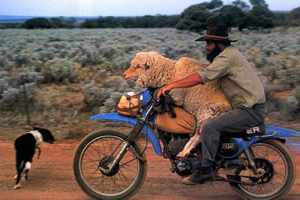
I press GO too hard, I press STOP too hard, I turn too hard and I laugh too hard. Even though I have broken a bone in every area of my clumsy body, one day they let me have a turn of riding the postie bike.

The biggest of my brothers decided to teach me how to fang the postie around the footy oval near our house. It was my first time. He was dinking on the back, patiently requesting I calm the fuck down. I was not very good at it. He held so much hope. Too Fast. Stop. Too Fast. Stop. Too Fast.

He jumped ship as the postie approached catastrophe – better one maimed child than two. I was forced to rely on my poor instinct to remain upright.  I pressed GO. Really hard. I should have pressed STOP. Really hard.

I plunged forward blindly and careered over a 6 metre deep embankment into an open water drain. Fwoof!  Gone. I went down as fast as lightening. Shaking bushes, slipping on grass, face forward towards an inevitable walloping.

I determinedly stayed on and rapidly approached the zenith of my humiliation.

The Biggest Brother flailed toward my assistance. The stress of potential damage to his bike and the incredulous belief that I still grasped the handlebars caused him an internal explosion.   He collapsed into the muddy channel.  He couldn’t breathe.

The postie paused briefly before I gave it the berries again. Really kicked it hard in the guts.

It became my moment of unexpected glory. I shot up the other side of the ditch, but unlike my descent, I’m riding like a boss, no outward appearance of any calamity. Mounted with dignity, I pop a few monos, hurtle through more bushes and even more mud before being expelled gracefully on the high side with both wheels off the ground.

I land and hinge my head to notice The Biggest Brother’s hilarious distress and feel the swarming glee of accomplished success. I twinkle at my sudden cleverness and shrug my shoulders nonchalantly.

“What? ”


Go Back